
Cottage Food Laws by State:
The Complete 2026 Guide for Home-Based Food Entrepreneurs
Right now, someone in every state in America is legally selling homemade food from their kitchen. Cookies in Texas. Kimchi in Montana. Tamales in California. Entire home-cooked meals in Wyoming.
And most of them started with the same question you probably have right now: “Is this even legal where I live?”
The short answer is yes. As of 2026, all 50 states and Washington, D.C. have some form of cottage food law on the books. But the details vary wildly. In Florida, you can earn up to $250,000 a year selling from your home kitchen. In some states, you’re capped at $25,000. A few states let you sell almost anything. Others limit you to shelf-stable baked goods.
I’ve been navigating food business regulations for over two decades, and I can tell you this: the regulatory landscape is shifting faster right now than at any point in the last 15 years. And it’s shifting in your favor.
This guide breaks down cottage food laws by state, covers the biggest legislative changes in 2025 and 2026, and gives you an actionable plan to start selling legally. At the bottom, you’ll find a complete directory of every state’s food regulatory agency with direct contact information.
What Are Cottage Food Laws (And Why Should You Care)?
Cottage food laws allow individuals to prepare and sell certain food products from their home kitchens without a commercial kitchen, full food service license, or health department inspection. The concept is simple: low-risk foods made in a home kitchen pose minimal public health risk, so the regulatory burden should be proportionally low.
In practical terms, this means you can start a food business with almost no upfront investment. No commercial kitchen lease. No five-figure buildout. In many states, no permit fees at all.
All 50 states + D.C. now have cottage food programs. Since 2015, 34 states have either created new homemade food programs or expanded existing laws. (Source: Institute for Justice)
The foods typically allowed under cottage food laws include baked goods, jams, jellies, honey, candies, dry mixes, granola, and other shelf-stable items that don’t require refrigeration. These are technically called “non-potentially hazardous” or “non-TCS” foods.
If you’re researching cottage food business ideas, understanding your state’s cottage food law is literally step one.
The 2025–2026 Landscape: 5 Changes That Matter
Cottage food legislation is evolving rapidly. Here are the five most significant shifts happening right now, based on legislative tracking from the National Agricultural Law Center and the Institute for Justice.
1. Revenue Caps Are Rising Significantly
Multiple states raised their annual sales caps in 2025. Texas jumped to $150,000 (SB 541). Florida leads the nation at $250,000. Michigan doubled its cap to $50,000 with HB 4122. Vermont expanded from a weekly limit of $125 to an annual cap of $30,000. Perhaps more importantly, states like Oregon, California, Michigan, and Minnesota have started indexing their caps to inflation, meaning your earning potential will grow automatically.
2. Online Sales and Delivery Are Expanding Fast
The majority of states now allow online ordering of cottage food products, a dramatic shift from just five years ago when most states required face-to-face transactions only. Michigan and North Dakota both legalized online sales and shipping in 2025. Minnesota will allow shipping within the state starting in 2027. This trend reflects the reality that modern food businesses operate on Instagram and DoorDash just as much as at the farmers’ market.
3. The Refrigeration Barrier Is Breaking
Traditionally, cottage food laws only covered shelf-stable items. That’s changing. At least nine states now allow certain perishable TCS (Time/Temperature Control for Safety) foods from home kitchens, including California, Iowa, Montana, North Dakota, Oklahoma, Utah, Wyoming, and Texas (as of September 2025). These typically require additional food safety training, but they dramatically expand what you can sell.
9+ states now allow perishable foods from home kitchens under cottage food or food freedom laws, up from just 2 states a decade ago.
4. Food Freedom Laws Are Gaining Momentum
Five states (Wyoming, Montana, North Dakota, Utah, and Oklahoma) have gone beyond traditional cottage food laws with “Food Freedom” acts. These laws let residents sell almost any homemade food (except meat) without licensing, permits, or inspections. Here’s what’s remarkable: according to state health departments in Wyoming, North Dakota, and Utah, there has not been a single outbreak of foodborne illness linked to a food freedom business. Maine has taken a different path, with nearly 100 municipalities passing local food sovereignty ordinances.
5. Privacy Protections Are Improving
States are increasingly addressing a real concern for home-based sellers: putting your home address on every label. Texas, Oklahoma, and Maryland now allow cottage food producers to use a state-issued registration number instead of their home address. Michigan offers optional MSU Product Center registration for address privacy.
Quick-Reference: How Top States Compare
Every state’s cottage food law is different. This chart compares ten of the most notable programs to give you a snapshot of the range. Always verify current rules with your state agency (directory below).
| State | Revenue Cap | Foods Allowed | Where You Can Sell | Permits Needed | Pre-empts Local? |
| Florida | $250,000 | Shelf-stable | Online, delivery, retail, farmers market | Registration | No |
| Texas | $150,000 | Shelf-stable + TCS (with training) | Online, delivery, retail, farmers market | Registration (DSHS for TCS) | Yes (SB 541) |
| California | $75,000 (Class B) | Shelf-stable + TCS (Class B) | Online, delivery, farmers market | Registration + inspection (Class B) | No |
| Michigan | $50,000 | Shelf-stable only | Online, shipping, delivery, farmers market | None required | No |
| Wyoming* | No cap | Nearly all foods (no meat) | Direct to consumer, online | None required | N/A (Food Freedom) |
| North Dakota* | No cap | Nearly all foods (no meat) + TCS | Online, mail, consignment, out-of-state | None required | N/A (Food Freedom) |
| Minnesota | $78,000 | Shelf-stable + canned goods | Farmers market, direct, (shipping 2027) | Registration + training | No |
| Oregon | $50,000 | Shelf-stable | Online, farmers market, direct | Registration + food safety training | Yes (inflation adj.) |
| Vermont | $30,000 | Shelf-stable | Direct, farmers market | Registration | No |
| Illinois | $50,000 (Tier 1) / No cap (Tier 2) | Shelf-stable + some TCS | Online, delivery, farmers market, retail | Registration + training | No |
*Food Freedom states. These operate under separate legislation from traditional cottage food laws.
How Cottage Food Laws Actually Work: The 5 Variables
Every state’s cottage food law is built around the same five variables. When you research your state, these are the questions you need answered.
1. What can you sell? Most states maintain a list of approved food categories. Common items include baked goods, candies, jams, jellies, honey, dry mixes, coffee, tea, popcorn, and granola. Some states use a “positive list” (only what’s listed is allowed), while others use a “negative list” (everything is allowed except what’s prohibited). This distinction matters for deciding what food is easy to sell.
2. Where can you sell? Selling venues range from the most restrictive (farmers’ markets only) to the most permissive (anywhere, including online and through third-party delivery). Forty-three states now allow online sales. Thirty-five allow some form of delivery. Twenty-two allow sales to retail stores.
3. How much can you earn? Annual revenue caps range from no limit at all (food freedom states) to $250,000 in Florida. If you’re serious about building a real business, your state’s cap will determine whether you eventually need a licensed commercial kitchen. I cover how to set prices for your food business.
4. What permits or training do you need? Requirements vary from nothing at all (Wyoming, Michigan) to registration plus food handler training plus kitchen inspection. Most states fall somewhere in between. Regardless of what your state requires, solid food safety practices protect both your customers and your business.
5. What labeling is required? Nearly every state requires labeling that includes your business name, ingredients list, allergen warnings, net weight, and a disclaimer like: “This product was produced in a home kitchen that is not subject to state health inspection.” Use the exact language your state requires.

5 Mistakes That Get Home Food Businesses Shut Down
These aren’t hypothetical. I’ve seen each of these trip up real people. Avoid them.
1. Selling across state lines without knowing it. Cottage food laws are state-specific. The moment you ship to a customer in another state, you’ve entered interstate commerce, which triggers federal FDA jurisdiction. Online sales make this easy to do accidentally. Know your boundaries.
2. Using the wrong label disclaimer. Each state has specific required wording for the cottage food disclaimer on your label. Close enough doesn’t count. Using a generic disclaimer from a template you found online can result in a violation. Get the exact wording from your state agency.
3. Exceeding your revenue cap without transitioning. This is a good problem to have, but it’s still a problem. If your state caps cottage food sales at $50,000 and you hit $51,000, you’re technically operating outside the law. Track your sales and plan your transition to a commercial kitchen before you hit the limit.
4. Ignoring local zoning rules. Some states pre-empt local regulations, meaning your city can’t add extra rules. Others don’t. Even in pre-emption states, basic zoning laws about running a business from your home may still apply. One phone call to your city zoning office can save you a major headache.
5. Selling prohibited foods. Not every homemade food qualifies. Selling items that require refrigeration in a shelf-stable-only state, or selling meat products under a cottage food license, can get you shut down. When in doubt, ask your state agency before you sell.
Beyond Cottage Food: MEHKO and the Home Restaurant Model
If you want to sell prepared meals that include meat, dairy, or other perishable items, traditional cottage food laws probably won’t cover you. But a newer model is emerging.
California pioneered the Microenterprise Home Kitchen Operation (MEHKO) program in 2018, which allows permitted home cooks to sell full meals directly to consumers. As of late 2024, Los Angeles County alone has issued over 100 MEHKO permits. Several other California counties are now active, and other states are studying the model.
A MEHKO permit in California allows up to $100,000 in annual revenue from your home kitchen. If you’re interested in a meal prep business from home, this is the pathway to watch.
Your 5-Step Startup Action Plan
Don’t let regulation paralysis stop you. Here’s how to go from “I want to sell food from home” to legally operating, typically within two to four weeks.
Step 1: Find your state’s specific rules. Use the directory at the bottom of this article. Contact your state’s food regulatory agency by email first (you’ll want written answers), then follow up by phone if needed.
Step 2: Check local requirements. Call your county health department and your city’s zoning office. Ask specifically about home-based food production. Record every name, number, and answer.
Step 3: Complete required training and registration. If your state requires food handler training, complete it online (most are a few hours and under $20). This is not the barrier people think it is.
Step 4: Get your labeling right. Before you sell a single item, make sure your labels comply with your state’s exact requirements. Incorrect labeling is the most common compliance issue, and the easiest to prevent.
Step 5: Start selling. Don’t wait for perfection. Start at a farmers’ market, take orders through social media, or supply a local coffee shop. The best marketing strategies for home food businesses don’t require a big budget.
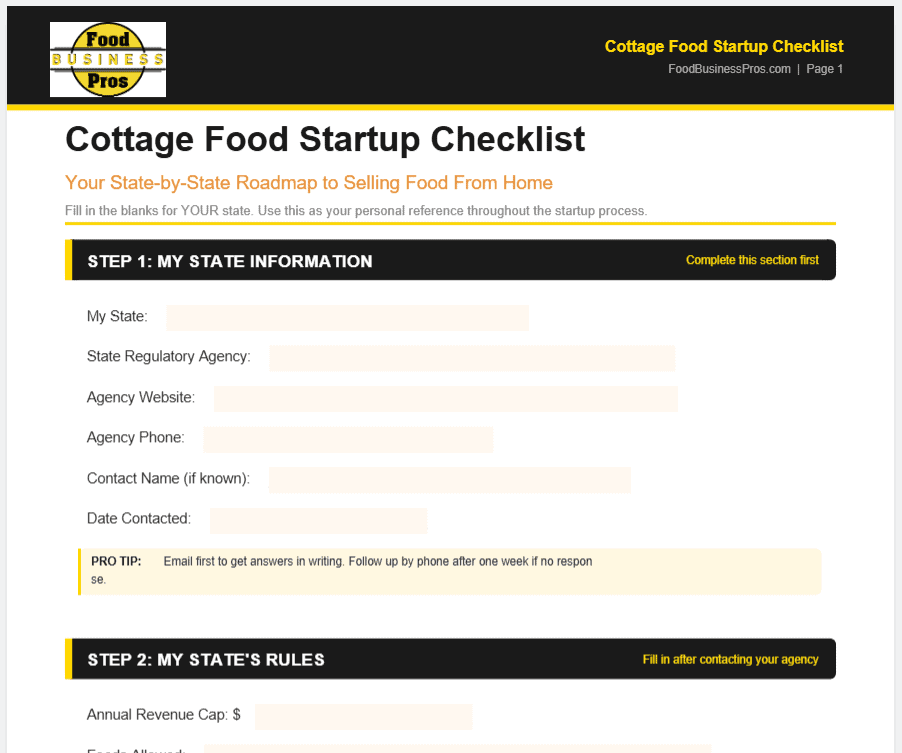
⭐ FREE DOWNLOAD: Cottage Food Startup Checklist A printable, fillable checklist you can customize for your state. Covers regulations research, permits, training, labeling, and your first 30 days of sales.
49% of new business owners in 2023 were women (up from 29% in 2019). Cottage food businesses are a leading entry point for women, rural residents, and immigrants.
Gusto/Guidant Financial
State-by-State Food Regulatory Directory
Below is a directory of the primary food regulatory agency for every U.S. state plus Washington, D.C. These are the offices that administer cottage food laws, food business licensing, and food safety inspections.
Important: This directory was verified in February 2026. Agency names, URLs, and phone numbers can change. If you find a broken link, please contact me so I can update it.
| State | Regulatory Agency | Website | Phone |
| Alabama | Dept. of Public Health – Food Safety | Visit Website | (334) 206-5375 |
| Alaska | Dept. of Environmental Conservation – Food Safety | Visit Website | (907) 269-7501 |
| Arizona | Dept. of Health Services – Food Safety | Visit Website | (602) 542-1025 |
| Arkansas | Dept. of Health – Food Protection | Visit Website | (501) 661-2171 |
| California | Dept. of Public Health – Food Safety | Visit Website | (916) 650-6500 |
| Colorado | Dept. of Public Health & Environment – Retail Food | Visit Website | (303) 692-3645 |
| Connecticut | Dept. of Consumer Protection – Food & Standards | Visit Website | (860) 713-6160 |
| Delaware | Dept. of Health – Office of Food Protection | Visit Website | (302) 744-4546 |
| Florida | Dept. of Agriculture – Food Safety | Visit Website | (850) 245-5520 |
| Georgia | Dept. of Agriculture – Food Safety | Visit Website | (404) 656-3627 |
| Hawaii | Dept. of Health – Sanitation Branch | Visit Website | (808) 586-8000 |
| Idaho | Dept. of Health – Food Protection | Visit Website | (208) 334-5500 |
| Illinois | Dept. of Public Health – Food, Drugs & Dairies | Visit Website | (217) 785-2439 |
| Indiana | Dept. of Health – Food Protection | Visit Website | (317) 234-8569 |
| Iowa | Dept. of Inspections – Food & Consumer Safety | Visit Website | (515) 281-6538 |
| Kansas | Dept. of Agriculture – Food Safety & Lodging | Visit Website | (785) 564-6767 |
| Kentucky | Cabinet for Health – Food Safety Branch | Visit Website | (502) 564-7181 |
| Louisiana | Dept. of Health – Retail Food | Visit Website | (225) 342-9500 |
| Maine | Dept. of Agriculture – Quality Assurance & Regulations | Visit Website | (207) 287-3841 |
| Maryland | Dept. of Health – Food Safety | Visit Website | (410) 767-8400 |
| Massachusetts | Dept. of Public Health – Food Protection | Visit Website | (617) 624-5757 |
| Michigan | Dept. of Agriculture – Food Safety | Visit Website | (800) 292-3939 |
| Minnesota | Dept. of Agriculture – Dairy & Food Inspection | Visit Website | (651) 201-6027 |
| Mississippi | Dept. of Health – Food Safety | Visit Website | (601) 576-7689 |
| Missouri | Dept. of Health – Food Safety | Visit Website | (573) 751-6400 |
| Montana | Dept. of Public Health – Food & Consumer Safety | Visit Website | (406) 444-2408 |
| Nebraska | Dept. of Agriculture – Food Safety | Visit Website | (402) 471-2341 |
| Nevada | Dept. of Health – Food Establishment Program | Visit Website | (775) 684-4200 |
| New Hampshire | Dept. of Health – Food Protection | Visit Website | (603) 271-4589 |
| New Jersey | Dept. of Health – Food & Drug Safety | Visit Website | (609) 826-4935 |
| New Mexico | Environment Dept. – Food Program | Visit Website | (505) 476-8600 |
| New York | Dept. of Agriculture – Food Safety | Visit Website | (518) 457-4492 |
| North Carolina | Dept. of Agriculture – Food & Drug Protection | Visit Website | (919) 733-7366 |
| North Dakota | Dept. of Health – Food & Lodging | Visit Website | (701) 328-1291 |
| Ohio | Dept. of Agriculture – Food Safety | Visit Website | (614) 728-6250 |
| Oklahoma | Dept. of Agriculture – Food Safety | Visit Website | (405) 521-3864 |
| Oregon | Dept. of Agriculture – Food Safety | Visit Website | (503) 986-4720 |
| Pennsylvania | Dept. of Agriculture – Food Safety | Visit Website | (717) 787-4315 |
| Rhode Island | Dept. of Health – Food Protection | Visit Website | (401) 222-2749 |
| South Carolina | Dept. of Health – Food Protection | Visit Website | (803) 898-3432 |
| South Dakota | Dept. of Health – Food Safety | Visit Website | (605) 773-3361 |
| Tennessee | Dept. of Agriculture – Food & Dairy | Visit Website | (615) 837-5193 |
| Texas | Dept. of State Health Services – Food Establishments | Visit Website | (512) 834-6753 |
| Utah | Dept. of Agriculture & Food – Food Safety | Visit Website | (801) 538-7100 |
| Vermont | Agency of Agriculture – Food Safety | Visit Website | (802) 828-2433 |
| Virginia | Dept. of Agriculture – Food Safety | Visit Website | (804) 786-3520 |
| Washington | Dept. of Agriculture – Food Safety | Visit Website | (360) 902-1800 |
| West Virginia | Dept. of Health – Food Safety | Visit Website | (304) 558-2981 |
| Wisconsin | Dept. of Agriculture – Food Safety | Visit Website | (608) 224-4700 |
| Wyoming | Dept. of Agriculture – Consumer Health Services | Visit Website | (307) 777-6587 |
| Washington D.C. | Dept. of Health – Food Safety & Hygiene | Visit Website | (202) 535-2180 |
For a comprehensive legal reference, the National Agricultural Law Center’s cottage food compilation provides the full text of every state’s statute. The Farm-to-Consumer Legal Defense Fund’s cottage food map offers a helpful visual comparison.
The Bottom Line: Profit and Freedom Start Here
Here’s what I know after more than 20 years in the food business: the single biggest advantage of a home-based food business isn’t the low overhead or the flexible schedule, though those are real. It’s the freedom to build something that’s yours.
Cottage food laws exist specifically to lower the barrier between you and that freedom. The legislation is expanding. Revenue caps are rising. Online sales are becoming standard. The legal pathway to selling food from your home has never been wider or clearer.
But a pathway only matters if you walk it.
So here’s your next step: scroll back up to the state directory, find your state, and contact them this week. Get the specific rules for your situation in writing. Then pick your product, set your price, and get to work.
If you’re still deciding what kind of food business to start, our Food Business Ideas 2026 guide breaks down the most profitable options backed by real data. And if you want to hear from someone who’s actually done this, sign up for our Profit Playbook Emails. I share what’s working, what isn’t, and what I wish I’d known when I started.
You got this. Enjoy the journey.
~Stacey

